Unknown's avatar

About The Belugas are Watching

We write & illustrate children's books, blog a bit, cycle a bit (Michael), & drink coffee a lot, all under the watchful eyes of the belugas.

Tommy Says Goodnight

When we were in Kilkenny a few weeks ago we finally met Tommy, the hedgehog my cousin Yvonne rescued. She picked him out of the ditch on a dark night, having spotted him from her car. The vet warned Yvonne that if he fixed the hedgehog up she’d be stuck with him for life – Tommy had permanent damage to one leg which means he falls over every few steps. Five years later the vet sends all his clients with hedgehog questions to Yvonne!

Roll the mouse over each image for commentary…

While we visited Tommy was showing signs of going into hibernation, staying in bed for days on end, not coming out to eat or drink. Yvonne took him out of his box to change his bedding one last time before the big sleep. We said hello but he was not impressed!

A Cathedral and a ‘Witch’

St Canice’s Cathedral in Kilkenny is full of wonders. Here’s a smattering of them for you.

It has a round tower (9th century) which can be climbed to the top by the public -and there were some folk wildly waving from it when we got there on our recent visit to the city of the Cats.

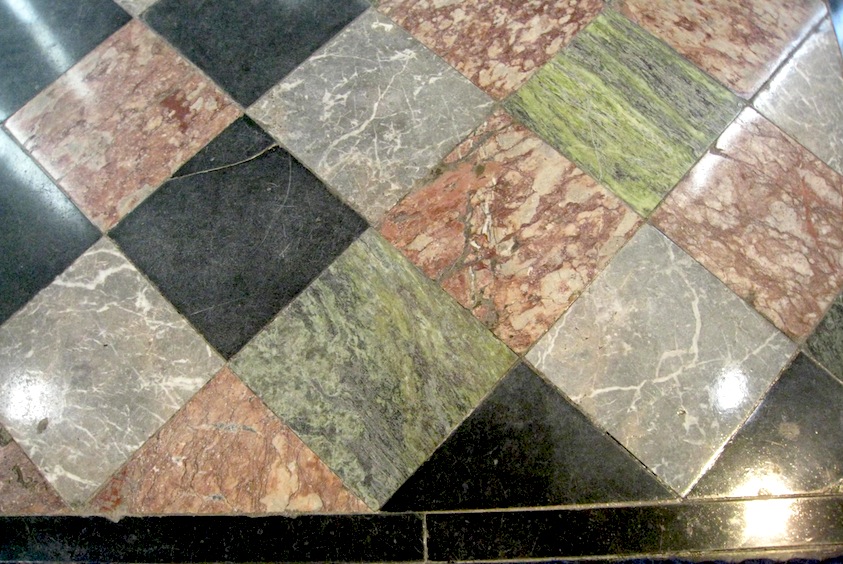
The altar floor is covered in marble of four colours, one from each province in Ireland. Can you match colour – black, red, green, grey- to origin? See bottom of post for answer.

IMG_3194

The cathedral also has links to the infamous Alice Kytler, condemned as a witch by Bishop Ledrede in the 14th century. I was fascinated by Alice when I was a kid and her house was pointed out to me on one of our family trips.

Was she a ‘witch’, or just an educated and attractive woman who was unfortunate enough to lose not one, but four (wealthy) husbands? Whatever the truth is, Ledrede sentenced her to be burnt at the stake for the crime of witchcraft but the bold Dame Alice vanished, helped to escape by several influential men of the City. Her servant Petronella wasn’t so lucky and Ledrede had her burnt at the stake in 1324, setting the ‘trend’ for burning as a suitable way to dispatch a ‘witch’.

And then there are the mediaeval tombs. I have a really strong memory of seeing them as a child too. Click on any photo for a larger image and some info.

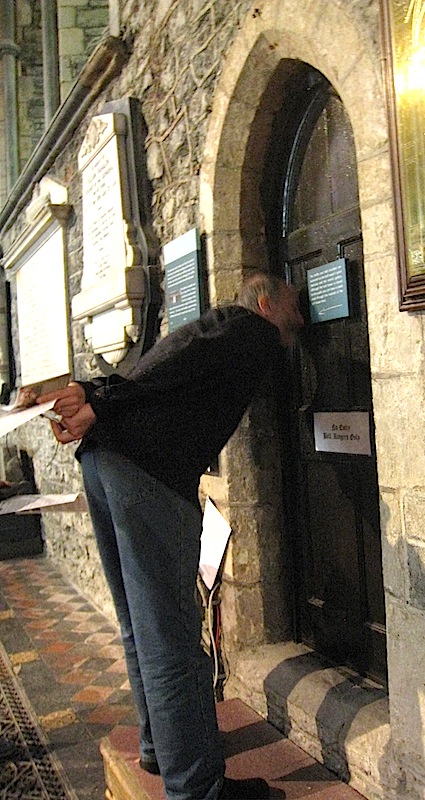
The cathedral is set up (when not in use for services) for visitors, with interesting, clear info sheets and some nice videos, including one of the bells being rung, which you peer at through the keyhole!

IMG_3205

Cill Channaigh (Irish for Kilkenny) means the church of Canice. Cathedral website http://www.stcanicescathedral.ie/index.html

Know your marbles? Green- Connaught, Connemara marble; black – Leinster, Kilkenny marble; grey – Munster, Cork marble; red – Ulster, Tyrone marble

On Friday it’s time to say good winter to Tommy the hedgehog…

Snow Queens and Morris Minors

When Sarah Webb asked Michael and myself to contribute illustrations to Beyond the Stars we were both very pleased to be included and very happy to work on something connected to such a good cause.

I was very flattered and a bit intimidated to be paired with Eoin Colfer on his atmospheric 1950’s set short story The Lookout. I even had a bit of a freak out before I established I could still do the type of realistic style drawings the story seemed to demand – it’s been a long time since I’ve worked in this way and I panicked! In the end I did enjoy doing this drawing of the vintage Morris Minor which features in the story, and I was eyeballing a school yearbook photo of Johnny Cash I pulled from the Internet when I drew the picture of Charley, the young protagonist.

Lookoutcar

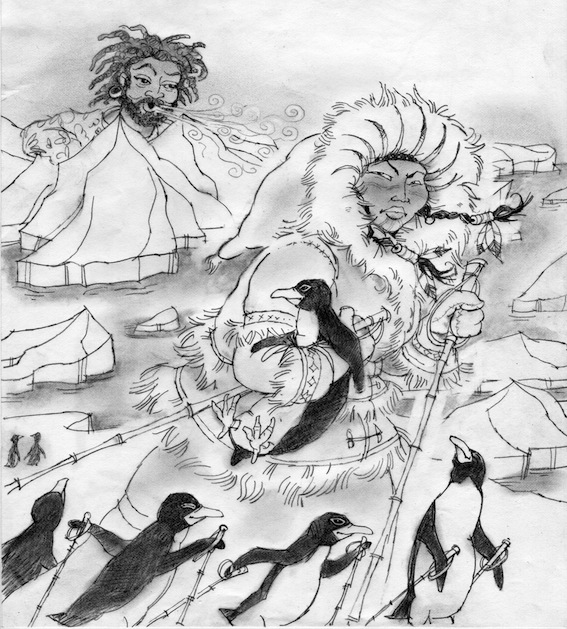
Michael was paired with Gordon Snell on his story, The Battle of the Ice Queen and he had some fun reimagining the Snow Queen. As you can see here, he avoided the usual blonde, white and skinny vision which is so much part of our European-centric culture.

The-Ice-Queenblog

Gordon was rather pleased with it!

IMG_1125

Beyond the Beyond

IMG_1109

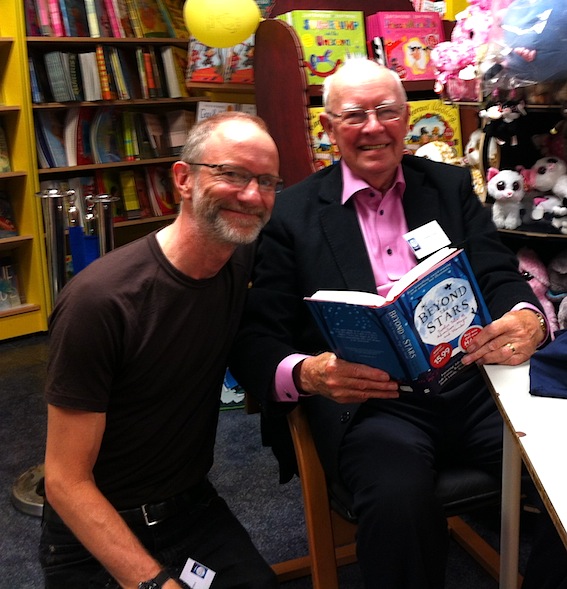
I’m not sure who was more excited about getting their books autographed the other night at the launch of Beyond the Stars; the punters or the authors and illustrators! Emma Brade, above front row, blue dress, found herself signing books too – she won the writing competition run for 8-16 year olds. The prize? Publication!

Beyond the Stars is a collection of short stories compiled by Sarah (the brave) Webb. Sarah and the folk at Harper Collins UK put twelve authors together with eleven illustrators (Oisin McGann illustrated his own story) and this book is the result. The stories are all set in winter and excellent for dark days under the duvet with a mug of hot cocoa. Best of all the proceeds go to Fighting Words, the creative writing centre here in Dublin. It is aimed at children and young adults and was set up by Roddy Doyle and Sean Love.

The launch featured a question and answer session introduced by Dave O’Callaghan and chaired by Elaina O’ Neill from CBI. Sarah was joined by Niamh Sharkey and Roddy Doyle, and they chatted about the stories, how it all came together (the term ‘herding cats’ was mentioned more than once), and the work done with children and teenagers at the Fighting Words centre.

Like all the other contributors I was anxious to get everyone’s signature on my copy of the book. As we all know each other well you’d think it wouldn’t be a big deal but we were all like, well, kids about it! I was rather star-struck getting Roddy Doyle’s sig, and then, guess what? He asked me (and everyone else) to sign his. Cool or what?

Here we are signing stacks of stock at Eason’s O’ Connell Street.

Afterwards we all went to the Gresham, had a few drinks and nibbles, and talked shop (as usual!)

Link to book: Beyond the Stars

Link to Fighting Words: http://www.fightingwords.ie/

In the order in which they appear in the book the authors are: Roddy Doyle, Derek Landy, John Boyne, Judi Curtin, Eoin Colfer, Marita Conlon McKenna, Michel Scott, Gordon Snell, Celine Kiernan, Oisín McGann, Siobhán Parkinson, Emma Brade, and the illustrators are: Steve Simpson, Alan Clarke, Paul Howard, Chris Judge, Marie-Louise Fitzpatrick, PJ Lynch, Chris Haughton, Michael Emberley, Tatyana Feeny, Oisín McGann, Olwyn Whelan, Niamh Sharkey

On Friday, a sneak peek at our contributions to the book.
 

The Attendant – London


We took a trip recently to the UK capital city to meet some book editors and meet up with dear friends and Irish cousins. London is a really great place for wasting time. I stumbled on this little place when on one of my “Michael walks” while Mel was visiting her editor. My walks tend to go in anything but a straight line. I criss cross the back streets, poking my nose down as many trendy mews and brick alleyways as I can.

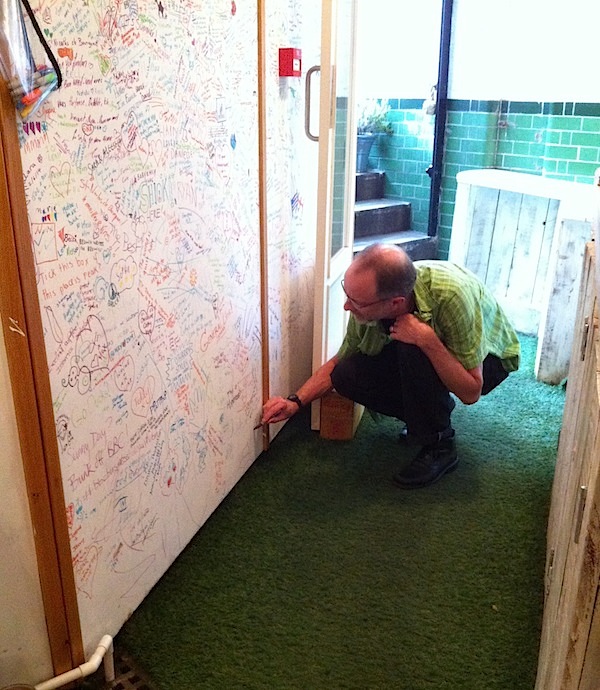
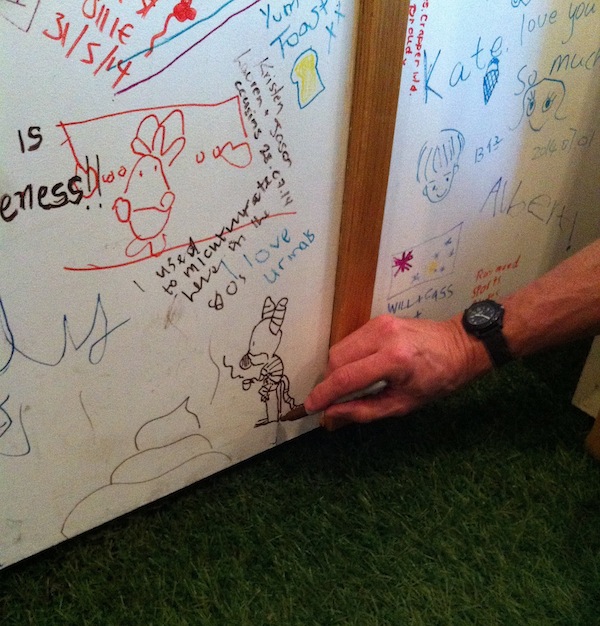
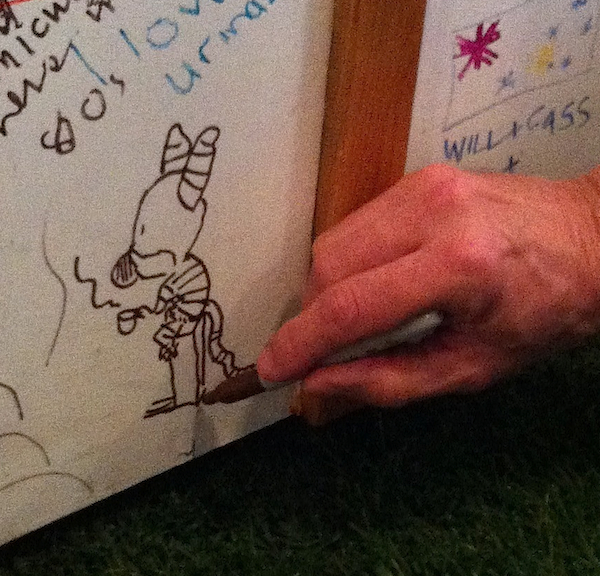
The Attendant is on a side street in London’s peaceful Fitzrovia area, not far from the roar of Oxford street. It’s an old Victorian underground urinal that has been converted to a coffee shop. The original wrought iron entrance is still there. You must walk down steep steps to get to the small counter and a couple mini seats, so it’s not exactly handicap accessible. But it’s a better place for warm weather anyway, when you can balance your espresso and cake as you negotiate the narrow stairs back up the street. And luckily it was particularly nice weather in London on our visit. IMG_0990Below, the original white porcelain urinals are still there, (looking immaculate I must say) converted now to individual mini counters with green metal stools. The coffee and eats were beyond excellent. If they weren’t I would have not gone back three times… IMG_1017 What illustrator can resist a wall of graffiti at the bottom of the stairs? Here I am stooping to the challenge. Not much on the way of fine art here I must say. IMG_1018 Here is my masterpiece on the only available space, right above the astroturf carpet. This is a kind of affirmation that I can take the pressure drawing in permanent ink in a public place. A few years ago I had the chance to draw on the unfinished wall in the lobby of Knopf publishers in NYC. It was so bad, I drew another one right away, much better, but the only space left was way up high and only seven foot visitors or authors on stilts will ever see it. They’ll just see the horrible, Michael-who-can’t-draw one, at eye level. Sigh. IMG_1019Ta Da! A comfortable looking “Gatto” sipping his latte on a stool. Not bad. Now if I had only drawn this one in New York…Untitled I was able to do a little work outside. on the laptop, when I eventually figured out London Wi-fi through BT. It was terrible. IMG_0989

Random Writers

IMG_2600

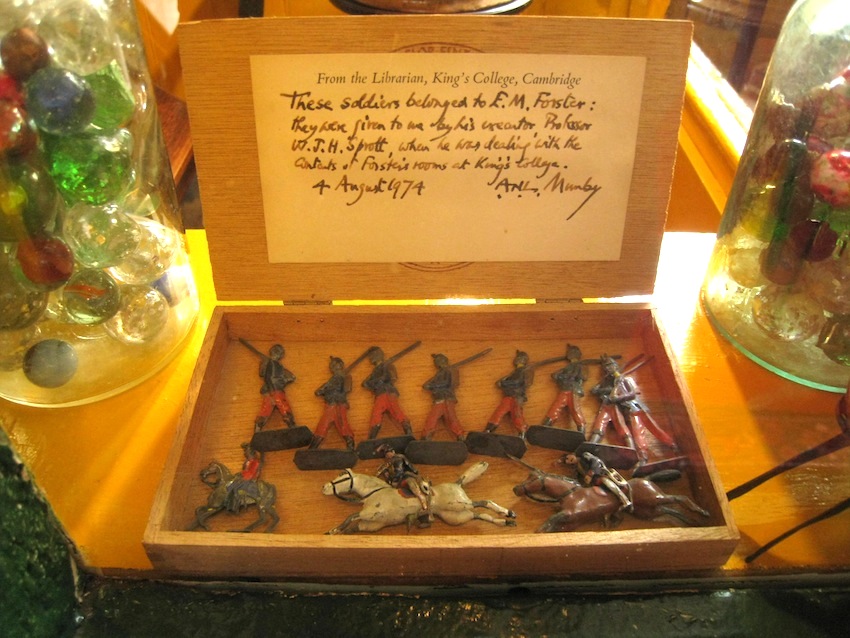
London is so saturated in connections to writers and literature you can just walk around and see what the streets throw up at you. We did two trips this year and as well as multiple ads in the underground for The Miniaturist and books by David Levithan (Every Day) we gathered a nice haul of Random Writers. At the Pollock Toy Museum we spotted these  toy soldiers belonging to E.M. Forster (Howards End, Room With a View).

Near our hotel we took a short cut through a cemetery – Bunhill Fields – without realising it is the burial place of many famous folk, including Daniel Defoe, John Bunyan, and William Blake. Mind you, they are a little vague about the exact whereabouts of Blake…

Baker Street is so full of nods to Sherlock Holmes I’m surprised they haven’t turned it into a theme park!

And this plaque to Beatrix Potter is one we stumbled over in 2011, it’s in Bolton Gardens, Kensington. The house was destroyed in the Blitz.

On our way to a pottery suppliers with our (pottering) friend Ann, we passed a house in Fitzroy Square where both George Bernard Shaw and Virginia Woolf once lived, though not at the same time. While searching for a specialist paper shop near Victoria Station we spotted a former abode of Joseph Conrad.

Gatwick Airport threw up one last random writer – Karen Blixen (Isak Dinesen). She was staring from the tail of a plane. I seem to remember from reading Out of Africa that she loved to fly so I’m sure she’d approve of this tribute from the Norwegian Airliner.

Inside the Pollock Toy Museum, Part 4 – War Toys

IMG_2653

For the last Toy Museum post here are some images of toys from the two World Wars, a mixture of comical and poignant.

And a couple of Cold War remnants – who can name all the USSR leaders? Note that the tiniest doll is…death!

http://www.pollockstoys.com/

Inside the Pollock Museum, Part 3 – miniature worlds

IMG_2646

Isn’t this a fab lav?

The miniature worlds in the toy museum were enchanting. Ann and myself fell heavily for the tiny grocer’s shop. We cooed over it for about ten minutes.

Michael and Eddie were more interested in the details of a large doll’s house. Below you’ll find images of a silversmith’s shop – remember those are not plastic pieces – a school room, a Noah’s ark, and furniture made from wishbones!!

As always, click on any photo to scroll through larger images. And if you’d like to share/comment the buttons are below. Next blog – War Toys

http://www.pollockstoys.com/

Inside the Pollock Museum, Part 2, the Dolls….

Visit The Pollock Toy Museum hereDolls. Thousands of ’em. When we stepped from the room at the top of the Victorian house (where Sooty and Sweep are) through the hole in the wall that leads into the Georgian house, we met some seriously scary dolls.

But we’ll start with the lovely/lovable/loved. And there are lots of those, many dolls with really sweet expressions. My absolute favourite was the Japanese doll with the beautiful face, several gorgeous outfits and her own furniture. One of her dressers is real lacquer.

Some of the dolls of old were slightly strange. I remember being fascinated by upside-down dolls when I was a kid, but not wanting to own one. My child’s mind couldn’t fathom playing with a doll with two heads and no legs, because I would always know that there was another half-doll hidden under the skirts. Googling the origins of this particular biracial ‘Topsy-Turvy’ doll made for interesting reading (link). It suggests the earliest versions where home-made ragdolls for black slave children, allowing the child to quickly switch to the white doll in front of the slave-master, who ‘didn’t want the slave children to have dolls that looked like themselves, which would give them a sense of empowerment.’

The Billiken doll was some sort of good luck charm. And then there is the cabbage baby (a sort of jack-in-the-box doll), the vaguely weird squeaky dolls (they look as if they’ve just been told off), and the Fräulein with the come hither pose…click on any photo to see the entire image.

And then.

Then there are the downright frightening. These two share a cabinet. We couldn’t help thinking the smug-faced doll had smashed cracked-faced doll’s head against the glass and now she is forever smiling at the damage done.

Perhaps the wax dolls once had sweet faces but I still can’t help thinking there must have been some traumatized little girls on Christmas days of yore! And what’s going on with the doll in the box? Is she an Ophelia doll??

And this one. Ahhhhh. The eyes. Ahhhhhhhhhhhhhhhhhhhhh!

IMG_2689

Next up, miniature worlds.

Visit The Pollock Toy Museum here

Inside The Pollock Toy Museum, Part 1

A 4000 yr old articulated toy mouse, recently authenticated.

So on our recent trip to London we finally got inside the Pollock Toy Museum. Eddie, being my cousin Sarah’s boyfriend, was kind enough to offer us a personal tour – an offer he lived to regret as we (Michael, our friend Ann, and myself) were so fascinated by everything it took us a full three and a half hours to travel through the museum. Eddie thinks that may be a record, broken only by a guy some years back who was loitering with criminal intent.

Eddie’s granny put the collection together and it’s housed inside two buildings, one Victorian, one Georgian. The two houses are crammed to the rafters with all sorts of toys from across the world, so many treasures that it will need four blogs to just give you a taste of it! First up a group of photos from across the collection. Click on an image if you’d like to scroll/get more details…have a guess at what those lovely shadow puppets might be made from before you do!

Of course we came across toys from our own childhoods. I had a mini meltdown at the case containing Sooty and Sweep. And Soo. For a moment I could see our old black and white telly and my toddler legs in white ankle socks and Jumping Jack shoes sticking out in front of me as I sat on one of the armchairs, watching. In the sixties themed glass case there was a game called Coppit – I remembered the box immediately, and my disappointment on opening it to find that the playing pieces were just cones, not hats with little people attached. And there was Dougal and the Magic Roundabout. I had to explain all the above to Michael and Ann as these were not part of their American childhoods.

The Gollywogs – I’m turning pink just typing that- took a bit more explaining. It seems so astonishing now that these toys were a ‘normal’ part of an Irish/UK sixties childhood, as was watching The Black and White Minstrel Show – white women singing and dancing with white men wearing blackface. Some of the many things we didn’t think twice about, just accepted as life as we knew it. Makes me wonder what we do now which will strike us as alien and unacceptable in twenty/thirty years time. Our childhood Gollys were knitted by our mam from patterns in the Woman’s Weekly. Here is Wikipedia’s info on Florence Kate Upton and the history of Golly Dolls.

On Friday, Dolls! The museum is packed with them, the too-beautiful-to-play-with, the much-loved, and the down-right weird.
http://www.pollockstoys.com/